
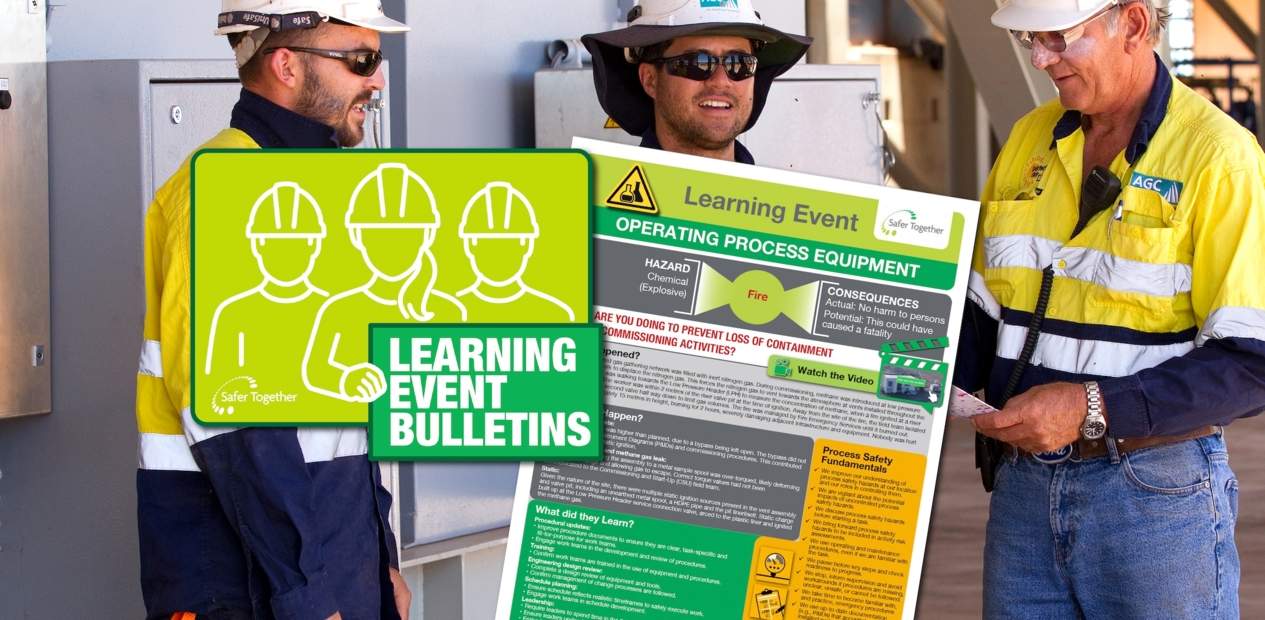
Our suite of Quarter 1-themed resources includes Learning Event Bulletins that align with the theme ‘Preventing Major Accidents’.
Learning Event Bulletins are a tool to assist with learning from unwanted events and/or threats to minimise Fatalities and Permanent Impairment incidents (FPIs).
They focus on ‘unwanted events/threats’ as triggers to investigate and disseminate lessons learned. Encourage industry to approach unwanted events/threats with a positive learning mindset. Investigate, report and share the lessons from ‘High Value Learning Events’ triggered by unwanted events/threats occurring, regardless of whether it is classified as a HiPo or not.
Use Learning Event Bulletins to facilitate discussions that influence and reinforce behaviours focused on helping prevent harm to frontline workers.
Learning Event Bulletin: Operating Process Equipment - Fire

What Happened?
A newly constructed gas gathering network was filled with inert nitrogen gas. During commissioning, methane was introduced at low pressure from the live network to displace the nitrogen gas. This forces the nitrogen gas to vent towards the atmosphere at vents installed throughout the network. A worker was walking towards the Low-Pressure Header (LPH) to measure the concentration of methane, when a fire ignited at a riser valve on the LPH. The worker was within 2 metres of the riser valve pit at the time of ignition. Away from the site of the fire, the field team isolated the main valve and second valve halfway down to limit gas volumes. The fire was managed by Fire Emergency Services until it burned out. It reached approximately 15 metres in height, burning for 2 hours, severely damaging adjacent infrastructure and equipment. Nobody was hurt during this incident.
Why did it Happen?
Pressure and flow rate: Flow rate of methane was higher than planned, due to a bypass being left open. The bypass did not appear on Piping & Instrument Diagrams (P&IDs) and commissioning procedures. This contributed to both the leak and static ignition.
Flange management and methane gas leak: A stub flange connecting the assembly to a metal sample spool was over-torqued, likely deforming the face of the flange and allowing gas to escape. Correct torque values had not been communicated to the Commissioning and Start-Up (CSU) field team.
Static: Given the nature of the site, there were multiple static ignition sources present in the vent assembly and valve pit, including an unearthed metal spool, a HDPE pipe and the pit liner itself. Static charge built up at the Low-Pressure Header service connection valve, arced to the plastic liner and ignited the methane gas.
What did they Learn?
Procedural updates:
- Improve procedure documents to ensure they are clear, task-specific and fit-for-purpose for work teams.
- Engage work teams in the development and review of procedures.
Training:
- Confirm work teams are trained in the use of equipment and procedures.
Engineering design review:
- Complete a design review of equipment and tools.
- Confirm management of change processes are followed.
Schedule planning:
- Ensure schedule reflects realistic timeframes to safely execute work.
- Engage work teams in schedule development.
Leadership:
- Require leaders to spend time in the field to understand challenges.
- Ensure leaders understand the site conditions prior to decisions about the project.
- Embed culture of curiosity in leaders about risks and challenges.
- Improve communication and active listening skills.


How do you get the most value from this Bulletin?
Managers and HSE Advisers:
- Forward this email to your frontline leaders (e.g. supervisors and HSE Representatives).
Frontline leaders:
- Print the Bulletin and post it to notice boards.
- Use the Toolbox slide pack to discuss the Bulletin at site safety meetings (e.g. toolbox sessions, pre-start meetings, pre-tours). It is important that this discussion is two-way. Provide information about the Learning Event and lessons learnt AND use it as a chance to discuss “Could this happen to you?”
Frontline workers:
- Actively participate in discussions about this Bulletin.
- Ask your front-line leader to provide the opportunity to discuss the Bulletin and download and discuss the Toolbox with your work crew.
- Help your frontline leader provide feedback to Safer Together.
Send your feedback to Safer Together: [email protected].
