
Creating a workplace free from physical and psychological harm isn't just a leadership responsibility. Every one of us has a role to play. Whether that's speaking up, participating in safety conversations, supporting a teammate, or raising concerns when something doesn't feel right.
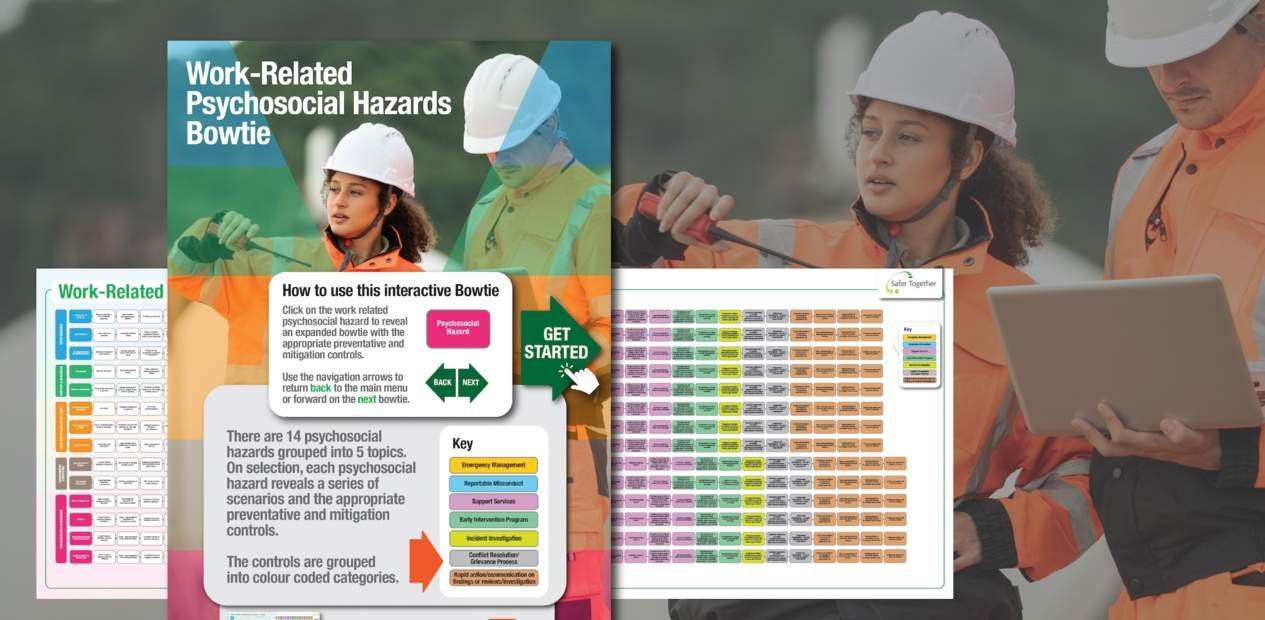
Our Health Working Group has now released a Work-Related Psychosocial Hazards Bowtie as a practical tool developed to help organisations identify, discuss and manage psychosocial hazards using a familiar bowtie risk management methodology. Built around the 14 psychosocial hazards identified by Safe Work Australia, it supports organisations to visualise preventative and mitigating controls and identify potential control gaps.
In this context, psychosocial safety is about the workplace. It's about identifying and managing work-related factors that could cause psychological and/or physical harm. Those hazards can come from things like the way work is designed, workload and demands, the work environment, the systems we use, or the way people interact with one another.
The Psychosocial Hazards Interactive Bowtie is built around the 14 psychosocial hazards identified by Safe Work Australia, grouping them into five key categories:
- Work Demands
- Support & Resources
- Role & Organisation Clarity
- Environment Conditions
- Relationships & Behaviours
The Bowtie is intended to complement existing regulatory and industry guidance by providing a practical mechanism to operationalise psychosocial hazard management. It is designed to assist duty holders in meeting their WHS obligations, while recognising that organisations remain responsible for undertaking their own psychosocial risk assessments and implementing controls appropriate to their operating context.
In the workplace, we manage psychosocial hazards the same way we manage any other risk:
- Identify the hazard,
- Assess the risk,
- Implement controls, and
- Review effectiveness.
On the left-hand side of the Bowtie are the preventative controls - these are the things we put in place to stop workers being exposed to the hazard in the first place.
On the right-hand side of the Bowtie are the mitigating controls - these are the things that help reduce the impact if exposure has already occurred.
At the centre of the Bowtie is the physical or psychological harm itself.
The Bowtie mirrors a risk management approach we're already familiar with, and is designed to provide members with a practical way to identify psychosocial hazards, discuss controls, and think about where gaps might exist.
Two documents are now available for download:
- Work-Related Psychosocial Hazards Bowtie
- Work-Related Psychosocial Hazards Bowtie – interactive document
If you would like further information on the Bowtie, get in touch with our Health Working Group: [email protected].