
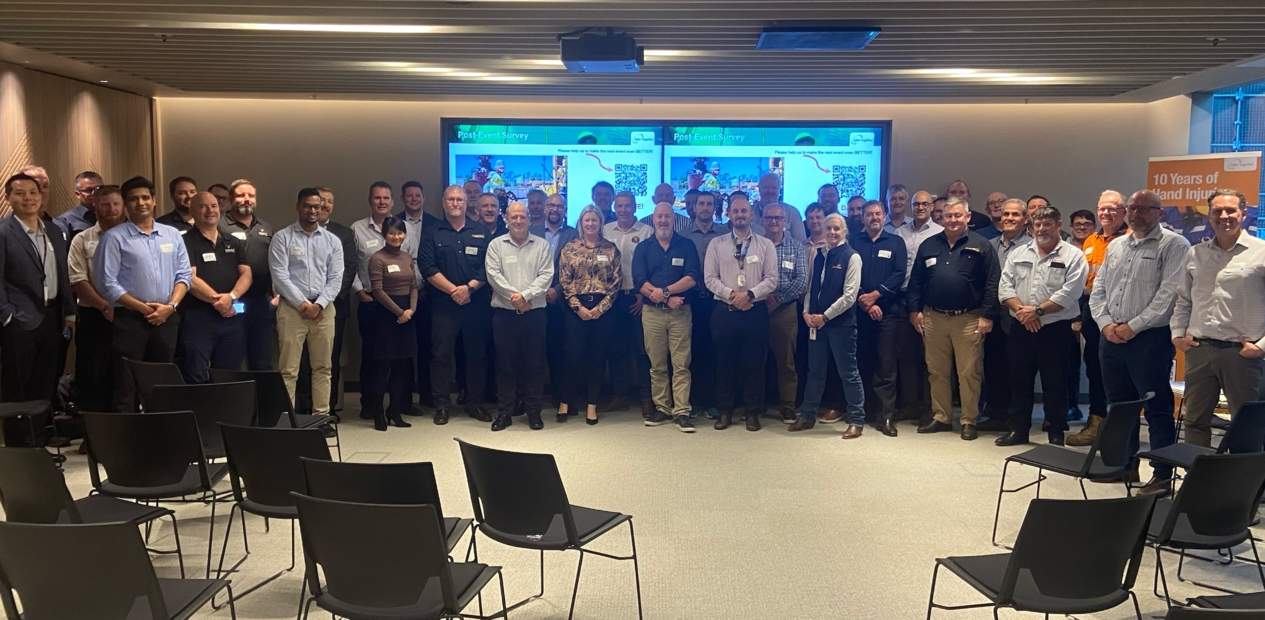
Brisbane’s drilling and completions industry came together for DCIIRP #43, to focus on improving hand and finger safety performance across Australia’s energy sector. The event brought together operators, drilling contractors, safety professionals to share lessons learned, discuss emerging risks and launch new initiatives aimed at reducing the occurrence of hand and finger injuries.
The event opened with a welcome and site briefing from Alan Ruff (Arrow Energy), who also delivered the Acknowledgement of Country. He acknowledged the support of the event sponsors Wild Desert and Arrow Energy, whose contributions helped make the forum possible.
The keynote presentation, “Choices & Leaders,” was delivered by James Wood (CNB Safe). Wood shared his personal story of a life-changing workplace accident and highlighted how a simple decision can have lasting consequences. His presentation emphasised the critical role good leadership plays in incident prevention.
Jason Burns (Wild Desert) presented a safety share on hand and finger injuries, reviewing two rig-move crush injury incidents involving pinch points on sliding walkways and hand-positioning rails. While engineering controls were introduced following the first incident, the second incident highlighted how inadequately assessed changes can inadvertently introduce new hazards. He stressed the importance of rapid access to specialist medical treatment for serious hand injuries, promoting a “right care, right place, first time” approach.
Jason’s key takeaways are that:
- engineering controls must be thoroughly assessed,
- management-of-change processes must be robust, and
- routine tasks should never be underestimated as injury risks.
John Hanrick (Savanna Energy Services), followed Jason with an incident investigation titled “Auto Slip Arm Contacts Floorhand’s Finger”, examining an incident in which a floorhand suffered a finger fracture when an auto-slip arm was inadvertently activated during bottom-hole assembly operations. John outlined the root causes, including a lack of engineered interlocks, reliance on verbal communication and shortcomings in risk assessment processes.
After a short break, Mike O’Connell (Santos) delivered an update on the Rig Site Safety Working Group’s Safety Improvement Plan focusing on injuries caused by camlocks, extension bars and baskets. He outlined efforts to eliminate high-risk tasks through equipment redesign and alternative tooling. The presentation covered work on rod locks, stuffing boxes and trials of new technologies including hydraulic chain pipe wrenches and compound wrenches. The project team continues to evaluate engineering solutions aimed at reducing manual handling exposure, minimising risks and improving overall safety performance.
A major feature of the event was a Hand and Finger Safety Workshop and Panel Discussion, which encouraged participants to identify practical solutions across four focus areas:
- Elimination – facilitated by Carlos Montilla (ChampionX),
- Design and engineering – facilitated by Mike O’Connell (Santos),
- Systems, procedures and training – facilitated by Kyle Koziol (Ventia), and
- Individual behaviour and culture – facilitated by Alan Ruff (Arrow Energy).
The Workshop wrap-up panel discussion was facilitated by Brendan Lynn (Arrow Energy).
Alan returned to provide an update on the Rig Site Safety Working Group (RSSWG), highlighting current industry programs related to training, tools and systems, information-sharing portals and hand and finger safety initiatives, before launching the RSSWG’s new Hand and Finger Safety Guideline.
The Guideline is intended to provide practical tools to help organisations reduce one of the industry’s most frequent injury types. It promotes a consistent industry-wide approach to managing hand and finger safety and reinforcing hands-free work practices across rig site operations. The initiative includes resources designed to support deployment of the Guideline - including posters, a pocket guide, implementation instructions, frequently asked questions and informational video content. Follow this link for full detail.
The event concluded with closing remarks, a post-event survey and a reminder to continue sharing safety learnings across the industry.
Members can view the event slide pack.
If you would like to join us at our next DCIIRP in Brisbane on 23rd September, get in touch